
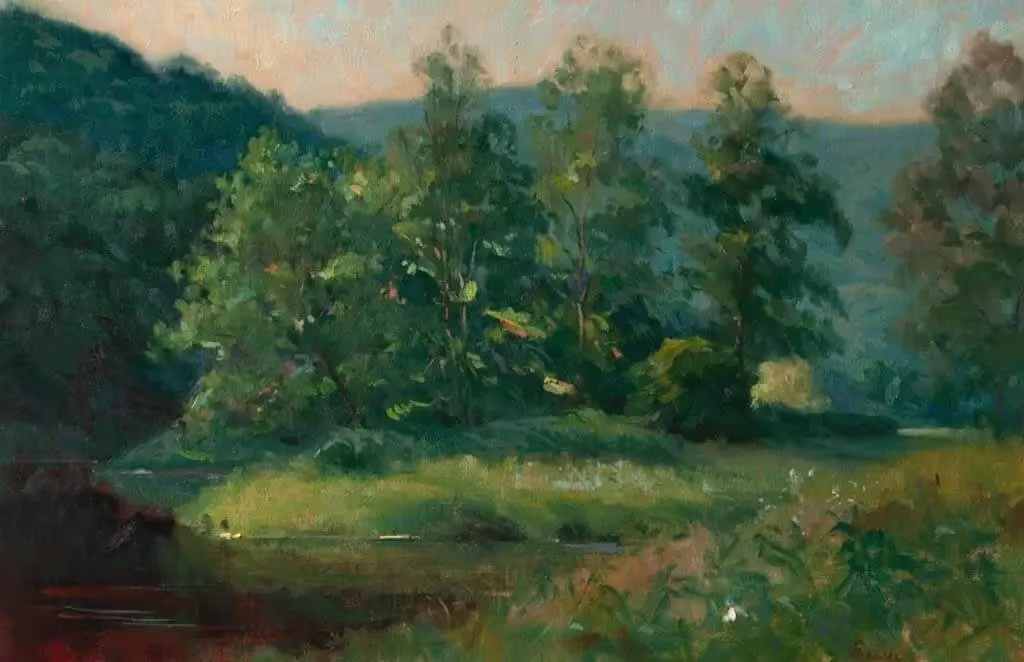
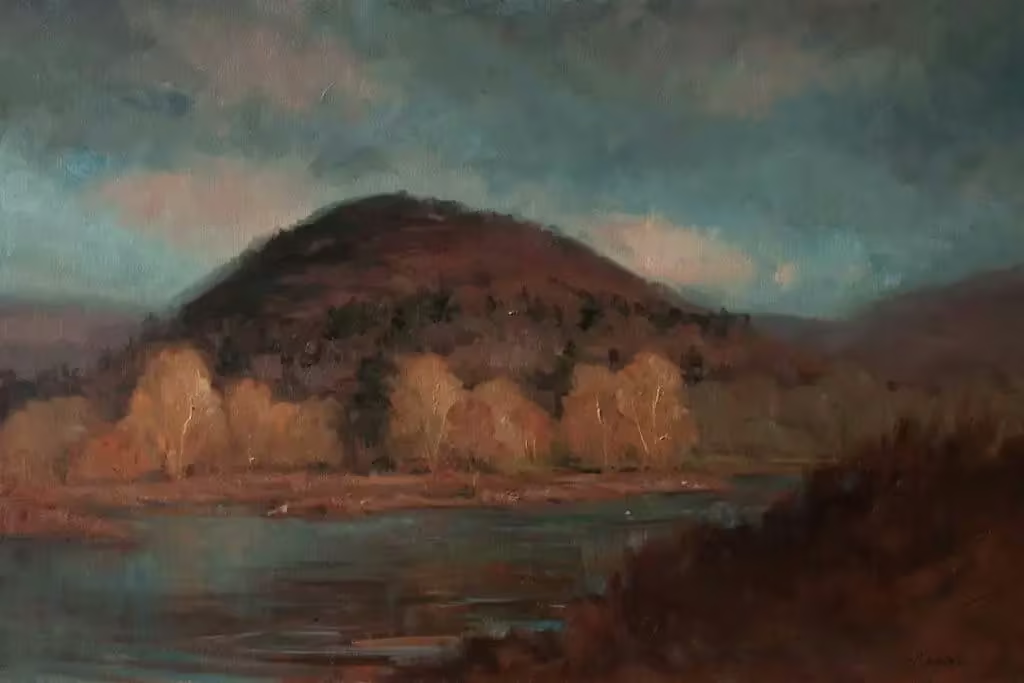
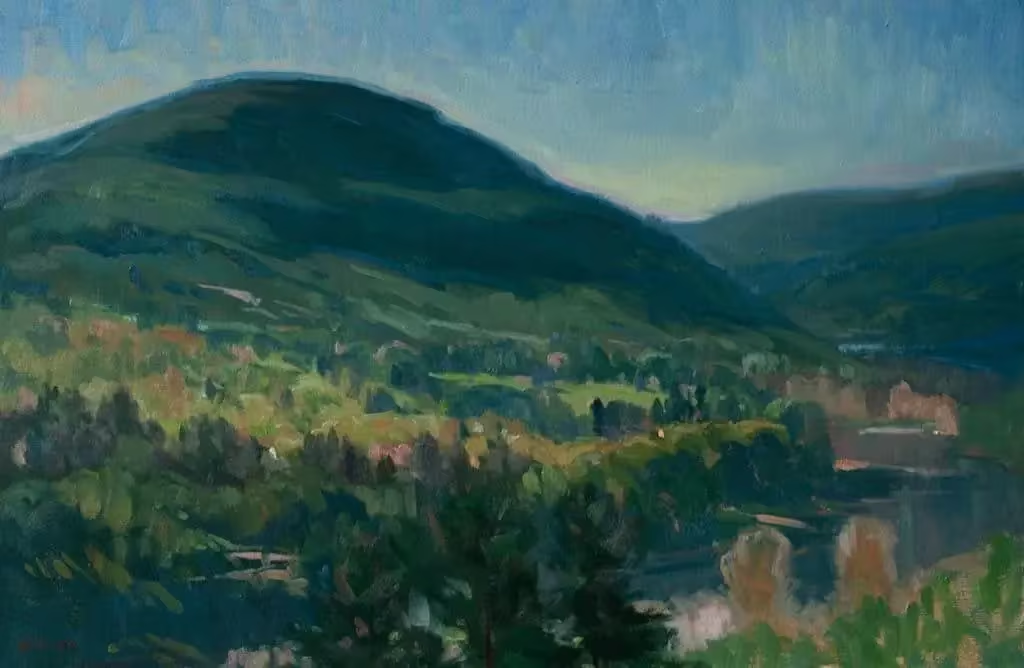
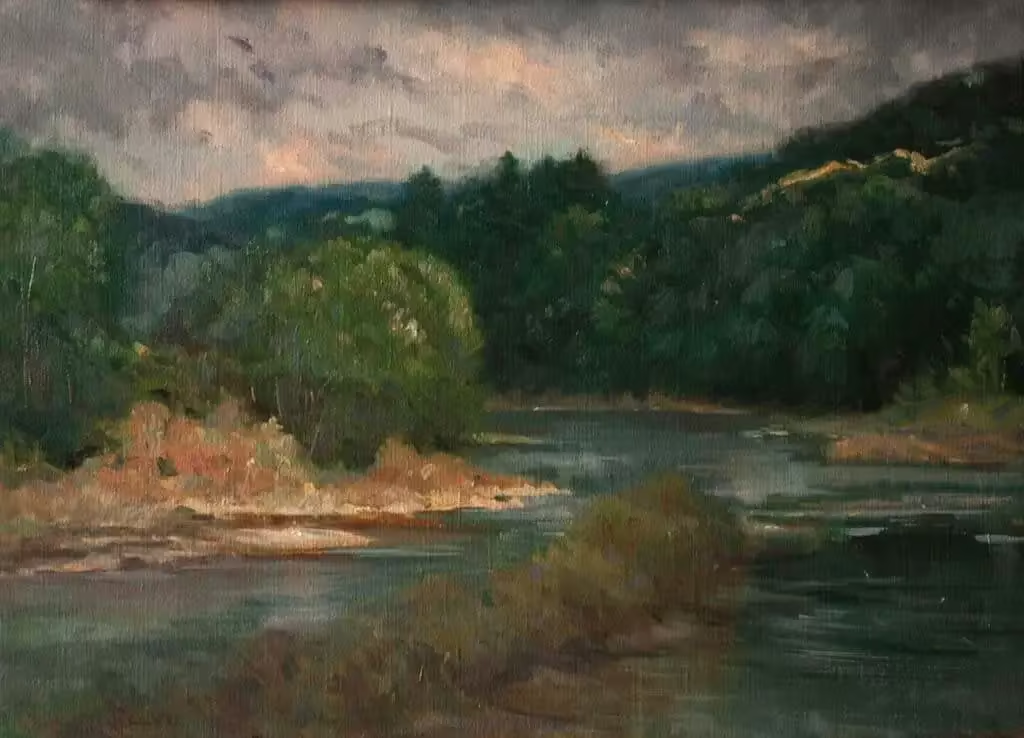
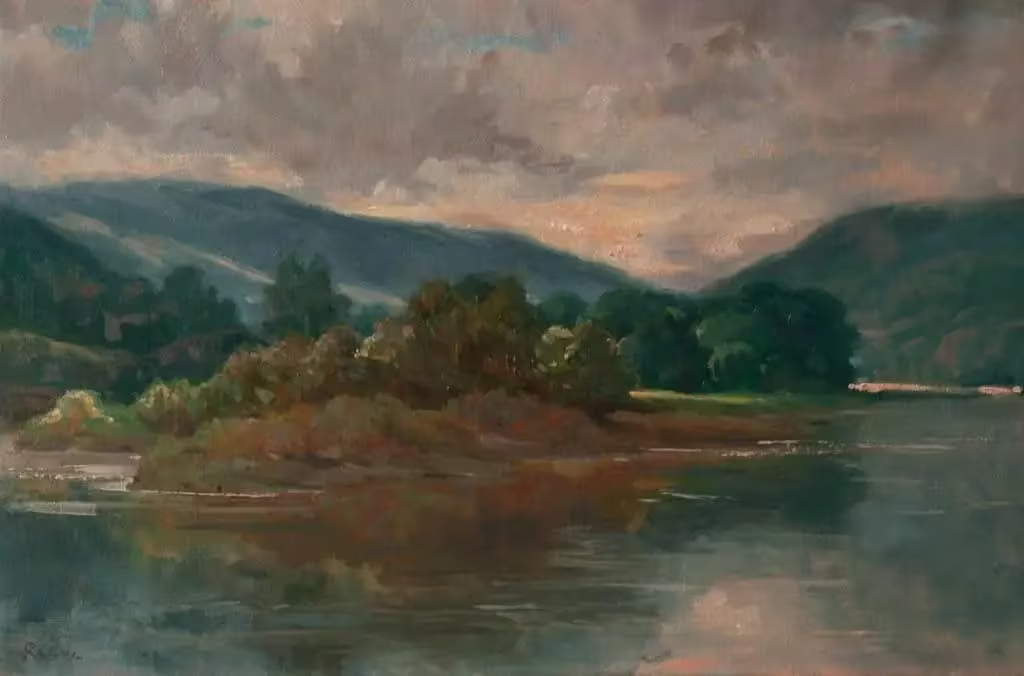
[First published in 1870 and now in the public domain, this ode to the speckled trout stands out as one of Burroughs’ most cherished essays, both for its details to life at his time and the insight it provides into the Upper Delaware River and its tributaries. This version is accompanied by paintings of the Upper Delaware River by Judith Reeve.]
“The forenoon had been fine, and we had brought into camp nearly three hundred trout…”
I
The legend of the wary trout, hinted at in the last sketch, is to be
further illustrated in this and some following chapters. We shall
get at more of the meaning of those dark water-lines, and I hope,
also, not entirely miss the significance of the gold and silver
spots and the glancing iridescent hues. The trout is dark and
obscure above, but behind this foil there are wondrous tints that
reward the believing eye. Those who seek him in his wild remote
haunts are quite sure to get the full force of the sombre and
uninviting aspects,–the wet, the cold, the toil, the broken rest,
and the huge, savage, uncompromising nature,–but the true angler
sees farther than these, and is never thwarted of his legitimate
reward by them.
I have been a seeker of trout from my boyhood, and on all the
expeditions in which this fish has been the ostensible purpose I
have brought home more game than my creel showed. In fact, in my
mature years I find I got more of nature into me, more of the woods,
the wild, nearer to bird and beast, while threading my native
streams for trout, than in almost any other way. It furnished a good
excuse to go forth; it pitched one in the right key; it sent one
through the fat and marrowy places of field and wood. Then the
fisherman has a harmless, preoccupied look; he is a kind of vagrant
that nothing fears. He blends himself with the trees and the
shadows. All his approaches are gentle and indirect. He times
himself to the meandering, soliloquizing stream; its impulse bears
him along. At the foot of the waterfall he sits sequestered and
hidden in its volume of sound. The birds know he has no designs upon
them, and the animals see that his mind is in the creek. His
enthusiasm anneals him, and makes him pliable to the scenes and
influences he moves among.
Then what acquaintance he makes with the stream! He addresses
himself to it as a lover to his mistress; he wooes it and stays with
it till he knows its most hidden secrets. It runs through his
thoughts not less than through its banks there; he feels the fret
and thrust of every bar and boulder. Where it deepens, his purpose
deepens; where it is shallow, he is indifferent. He knows how to
interpret its every glance and dimple; its beauty haunts him for
days.
I am sure I run no risk of overpraising the charm and attractiveness
of a well-fed trout stream, every drop of water in it as bright and
pure as if the nymphs had brought it all the way from its source
in crystal goblets, and as cool as if it had been hatched beneath a
glacier. When the heated and soiled and jaded refugee from the city
first sees one, he feels as if he would like to turn it into his
bosom and let it flow through him a few hours, it suggests such
healing freshness and newness. How his roily thoughts would run
clear; how the sediment would go downstream! Could he ever have an
impure or an unwholesome wish afterward? The next best thing he can
do is to tramp along its banks and surrender himself to its
influence. If he reads it intently enough, he will, in a measure, be
taking it into his mind and heart, and experiencing its salutary
ministrations.
Trout streams coursed through every valley my boyhood knew. I
crossed them, and was often lured and detained by them, on my way to
and from school. We bathed in them during the long summer noons, and
felt for the trout under their banks. A holiday was a holiday indeed
that brought permission to go fishing over on Rose’s Brook, or up
Hardscrabble, or in Meeker’s Hollow; all-day trips, from morning
till night, through meadows and pastures and beechen woods, wherever
the shy, limpid stream led. What an appetite it developed! a hunger
that was fierce and aboriginal, and that the wild strawberries we
plucked as we crossed the hill teased rather than allayed. When but
a few hours could be had, gained perhaps by doing some piece of
work about the farm or garden in half the allotted time, the little
creek that headed in the paternal domain was handy; when half a day
was at one’s disposal, there were the hemlocks, less than a mile
distant, with their loitering, meditative, log-impeded stream and
their dusky, fragrant depths. Alert and wide-eyed, one picked his
way along, startled now and then by the sudden bursting-up of the
partridge, or by the whistling wings of the “dropping snipe,”
pressing through the brush and the briers, or finding an easy
passage over the trunk of a prostrate tree, carefully letting his
hook down through some tangle into a still pool, or standing in some
high, sombre avenue and watching his line float in and out amid the
moss-covered boulders. In my first essayings I used to go to the
edge of these hemlocks, seldom dipping into them beyond the first
pool where the stream swept under the roots of two large trees. From
this point I could look back into the sunlit fields where the cattle
were grazing; beyond, all was gloom and mystery; the trout were
black, and to my young imagination the silence and the shadows were
blacker. But gradually I yielded to the fascination and penetrated
the woods farther and farther on each expedition, till the heart of
the mystery was fairly plucked out. During the second or third year
of my piscatorial experience I went through them, and through the
pasture and meadow beyond, and through another strip of hemlocks,
to where the little stream joined the main creek of the valley.
In June, when my trout fever ran pretty high, and an auspicious day
arrived, I would make a trip to a stream a couple of miles distant,
that came down out of a comparatively new settlement. It was a rapid
mountain brook presenting many difficult problems to the young
angler, but a very enticing stream for all that, with its two
saw-mill dams, its pretty cascades, its high, shelving rocks
sheltering the mossy nests of the phoebe-bird, and its general
wild and forbidding aspects.
But a meadow brook was always a favorite. The trout like meadows;
doubtless their food is more abundant there, and, usually, the good
hiding-places are more numerous. As soon as you strike a meadow the
character of the creek changes: it goes slower and lies deeper; it
tarries to enjoy the high, cool banks and to half hide beneath them;
it loves the willows, or rather the willows love it and shelter it
from the sun; its spring runs are kept cool by the overhanging
grass, and the heavy turf that faces its open banks is not cut away
by the sharp hoofs of the grazing cattle. Then there are the
bobolinks and the starlings and the meadowlarks, always interested
spectators of the angler; there are also the marsh marigolds, the
buttercups, or the spotted lilies, and the good angler is always an
interested spectator of them. In fact, the patches of meadow land
that lie in the angler’s course are like the happy experiences in
his own life, or like the fine passages in the poem he is reading;
the pasture oftener contains the shallow and monotonous places. In
the small streams the cattle scare the fish, and soil their element
and break down their retreats under the banks. Woodland alternates
the best with meadow: the creek loves to burrow under the roots of a
great tree, to scoop out a pool after leaping over the prostrate
trunk of one, and to pause at the foot of a ledge of moss-covered
rocks, with ice-cold water dripping down. How straight the current
goes for the rock! Note its corrugated, muscular appearance; it
strikes and glances off, but accumulates, deepens with well-defined
eddies above and to one side; on the edge of these the trout lurk
and spring upon their prey.
The angler learns that it is generally some obstacle or hindrance
that makes a deep place in the creek, as in a brave life; and his
ideal brook is one that lies in deep, well-defined banks, yet makes
many a shift from right to left, meets with many rebuffs and
adventures, hurled back upon itself by rocks, waylaid by snags and
trees, tripped up by precipices, but sooner or later reposing under
meadow banks, deepening and eddying beneath bridges, or prosperous
and strong in some level stretch of cultivated land with great elms
shading it here and there.
But I early learned that from almost any stream in a trout country
the true angler could take trout, and that the great secret was
this, that, whatever bait you used, worm, grasshopper, grub, or fly,
there was one thing you must always put upon your hook, namely, your
heart: when you bait your hook with your heart the fish always bite;
they will jump clear from the water after it; they will dispute with
each other over it; it is a morsel they love above everything else.
With such bait I have seen the born angler (my grandfather was one)
take a noble string of trout from the most unpromising waters, and
on the most unpromising day. He used his hook so coyly and tenderly,
he approached the fish with such address and insinuation, he divined
the exact spot where they lay: if they were not eager, he humored
them and seemed to steal by them; if they were playful and
coquettish, he would suit his mood to theirs; if they were frank and
sincere, he met them halfway; he was so patient and considerate, so
entirely devoted to pleasing the critical trout, and so successful
in his efforts,–surely his heart was upon his hook, and it was a
tender, unctuous heart, too, as that of every angler is. How nicely
he would measure the distance! how dexterously he would avoid an
overhanging limb or bush and drop the line exactly in the right
spot! Of course there was a pulse of feeling and sympathy to the
extremity of that line. If your heart is a stone, however, or an
empty husk, there is no use to put it upon your hook; it will not
tempt the fish; the bait must be quick and fresh. Indeed, a certain
quality of youth is indispensable to the successful angler, a
certain unworldliness and readiness to invest yourself in an
enterprise that doesn’t pay in the current coin. Not only is the
angler, like the poet, born and not made, as Walton says, but there
is a deal of the poet in him, and he is to be judged no more
harshly; he is the victim of his genius: those wild streams, how
they haunt him! he will play truant to dull care, and flee to them;
their waters impart somewhat of their own perpetual youth to him. My
grandfather when he was eighty years old would take down his pole as
eagerly as any boy, and step off with wonderful elasticity toward
the beloved streams; it used to try my young legs a good deal to
follow him, specially on the return trip. And no poet was ever more
innocent of worldly success or ambition. For, to paraphrase
Tennyson,–
“Lusty trout to him were scrip and share,
And babbling waters more than cent for cent.”
He laid up treasures, but they were not in this world. In fact,
though the kindest of husbands, I fear he was not what the country
people call a “good provider,” except in providing trout in their
season, though it is doubtful if there was always fat in the house
to fry them in. But he could tell you they were worse off than that
at Valley Forge, and that trout, or any other fish, were good
roasted in the ashes under the coals. He had the Walton requisite of
loving quietness and contemplation, and was devout withal. Indeed,
in many ways he was akin to those Galilee fishermen who were called
to be fishers of men. How he read the Book and pored over it, even
at times, I suspect, nodding over it, and laying it down only to
take up his rod, over which, unless the trout were very dilatory and
the journey very fatiguing, he never nodded!
II
The Delaware is one of our minor rivers, but it is a stream beloved
of the trout. Nearly all its remote branches head in mountain
springs, and its collected waters, even when warmed by the summer
sun, are as sweet and wholesome as dew swept from the grass. The
Hudson wins from it two streams that are fathered by the mountains
from whose loins most of its beginnings issue, namely, the Rondout
and the Esopus. These swell a more illustrious current than the
Delaware, but the Rondout, one of the finest trout streams in the
world, makes an uncanny alliance before it reaches its destination,
namely, with the malarious Wallkill.
In the same nest of mountains from which they start are born the
Neversink and the Beaverkill, streams of wondrous beauty that flow
south and west into the Delaware. From my native hills I could
catch glimpses of the mountains in whose laps these creeks were
cradled, but it was not till after many years, and after dwelling in
a country where trout are not found, that I returned to pay my
respects to them as an angler.
My first acquaintance with the Neversink was made in company with
some friends in 1869. We passed up the valley of the Big Ingin,
marveling at its copious ice-cold springs, and its immense sweep of
heavy-timbered mountain-sides. Crossing the range at its head, we
struck the Neversink quite unexpectedly about the middle of the
afternoon, at a point where it was a good-sized trout stream. It
proved to be one of those black mountain brooks born of innumerable
ice-cold springs, nourished in the shade, and shod, as it were, with
thick-matted moss, that every camper-out remembers. The fish are as
black as the stream and very wild. They dart from beneath the
fringed rocks, or dive with the hook into the dusky depths,–an
integral part of the silence and the shadows. The spell of the moss
is over all. The fisherman’s tread is noiseless, as he leaps from
stone to stone and from ledge to ledge along the bed of the stream.
How cool it is! He looks up the dark, silent defile, hears the
solitary voice of the water, sees the decayed trunks of fallen trees
bridging the stream, and all he has dreamed, when a boy, of the
haunts of beasts of prey–the crouching feline tribes, especially if
it be near nightfall and the gloom already deepening in the
woods–comes freshly to mind, and he presses on, wary and alert, and
speaking to his companions in low tones.
After an hour or so the trout became less abundant, and with nearly
a hundred of the black sprites in our baskets we turned back. Here
and there I saw the abandoned nests of the pigeons, sometimes half a
dozen in one tree. In a yellow birch which the floods had uprooted,
a number of nests were still in place, little shelves or platforms
of twigs loosely arranged, and affording little or no protection to
the eggs or the young birds against inclement weather.
Before we had reached our companions the rain set in again and
forced us to take shelter under a balsam. When it slackened we moved
on and soon came up with Aaron, who had caught his first trout, and,
considerably drenched, was making his way toward camp, which one of
the party had gone forward to build. After traveling less than a
mile, we saw a smoke struggling up through the dripping trees, and
in a few moments were all standing round a blazing fire. But the
rain now commenced again, and fairly poured down through the trees,
rendering the prospect of cooking and eating our supper there in the
woods, and of passing the night on the ground without tent or cover
of any kind, rather disheartening. We had been told of a bark
shanty a couple of miles farther down the creek, and thitherward we
speedily took up our line of march. When we were on the point of
discontinuing the search, thinking we had been misinformed or had
passed it by, we came in sight of a bark-peeling, in the midst of
which a small log house lifted its naked rafters toward the now
breaking sky. It had neither floor nor roof, and was less inviting
on first sight than the open woods. But a board partition was still
standing, out of which we built a rude porch on the east side of the
house, large enough for us all to sleep under if well packed, and
eat under if we stood up. There was plenty of well-seasoned timber
lying about, and a fire was soon burning in front of our quarters
that made the scene social and picturesque, especially when the
frying-pans were brought into requisition, and the coffee, in charge
of Aaron, who was an artist in this line, mingled its aroma with the
wild-wood air. At dusk a balsam was felled, and the tips of the
branches used to make a bed, which was more fragrant than soft;
hemlock is better, because its needles are finer and its branches
more elastic.
There was a spirt or two of rain during the night, but not enough to
find out the leaks in our roof. It took the shower or series of
showers of the next day to do that. They commenced about two o’clock
in the afternoon. The forenoon had been fine, and we had brought
into camp nearly three hundred trout; but before they were half
dressed, or the first panfuls fried, the rain set in. First came
short, sharp dashes, then a gleam of treacherous sunshine, followed
by more and heavier dashes. The wind was in the southwest, and to
rain seemed the easiest thing in the world. From fitful dashes to a
steady pour the transition was natural. We stood huddled together,
stark and grim, under our cover, like hens under a cart. The fire
fought bravely for a time, and retaliated with sparks and spiteful
tongues of flame; but gradually its spirit was broken, only a heavy
body of coal and half-consumed logs in the centre holding out
against all odds. The simmering fish were soon floating about in a
yellow liquid that did not look in the least appetizing. Point after
point gave way in our cover, till standing between the drops was no
longer possible. The water coursed down the underside of the boards,
and dripped in our necks and formed puddles on our hat-brims. We
shifted our guns and traps and viands, till there was no longer any
choice of position, when the loaves and the fishes, the salt and the
sugar, the pork and the butter, shared the same watery fate. The
fire was gasping its last. Little rivulets coursed about it, and
bore away the quenched but steaming coals on their bosoms. The
spring run in the rear of our camp swelled so rapidly that part of
the trout that had been hastily left lying on its banks again found
themselves quite at home. For over two hours the floods came down.
About four o’clock Orville, who had not yet come from the day’s
sport, appeared. To say Orville was wet is not much; he was better
than that,–he had been washed and rinsed in at least half a dozen
waters, and the trout that he bore dangling at the end of a string
hardly knew that they had been out of their proper element.
But he brought welcome news. He had been two or three miles down the
creek, and had seen a log building,–whether house or stable he did
not know, but it had the appearance of having a good roof, which was
inducement enough for us instantly to leave our present quarters.
Our course lay along an old wood-road, and much of the time we were
to our knees in water. The woods were literally flooded everywhere.
Every little rill and springlet ran like a mill-tail, while the main
stream rushed and roared, foaming, leaping, lashing, its volume
increased fifty-fold. The water was not roily, but of a rich
coffee-color, from the leachings of the woods. No more trout for the
next three days! we thought, as we looked upon the rampant stream.
After we had labored and floundered along for about an hour, the
road turned to the left, and in a little stumpy clearing near the
creek a gable uprose on our view. It did not prove to be just such a
place as poets love to contemplate. It required a greater effort of
the imagination than any of us were then capable of to believe it
had ever been a favorite resort of wood-nymphs or sylvan deities.
It savored rather of the equine and the bovine. The bark-men had
kept their teams there, horses on the one side and oxen on the
other, and no Hercules had ever done duty in cleansing the stables.
But there was a dry loft overhead with some straw, where we might
get some sleep, in spite of the rain and the midges; a double layer
of boards, standing at a very acute angle, would keep off the
former, while the mingled refuse hay and muck beneath would nurse a
smoke that would prove a thorough protection against the latter. And
then, when Jim, the two-handed, mounting the trunk of a prostrate
maple near by, had severed it thrice with easy and familiar stroke,
and, rolling the logs in front of the shanty, had kindled a fire,
which, getting the better of the dampness, soon cast a bright glow
over all, shedding warmth and light even into the dingy stable, I
consented to unsling my knapsack and accept the situation. The rain
had ceased, and the sun shone out behind the woods. We had trout
sufficient for present needs; and after my first meal in an
ox-stall, I strolled out on the rude log bridge to watch the angry
Neversink rush by. Its waters fell quite as rapidly as they rose,
and before sundown it looked as if we might have fishing again on
the morrow. We had better sleep that night than either night before,
though there were two disturbing causes,–the smoke in the early
part of it, and the cold in the latter. The “no-see-ems” left in
disgust; and, though disgusted myself, I swallowed the smoke as best
I could, and hugged my pallet of straw the closer. But the day
dawned bright, and a plunge in the Neversink set me all right again.
The creek, to our surprise and gratification, was only a little
higher than before the rain, and some of the finest trout we had yet
seen we caught that morning near camp.
We tarried yet another day and night at the old stable, but taking
our meals outside squatted on the ground, which had now become quite
dry. Part of the day I spent strolling about the woods, looking up
old acquaintances among the birds, and, as always, half expectant of
making some new ones. Curiously enough, the most abundant species
were among those I had found rare in most other localities, namely,
the small water-wagtail, the mourning ground warbler, and the
yellow-bellied woodpecker. The latter seems to be the prevailing
woodpecker through the woods of this region.
That night the midges, those motes that sting, held high carnival.
We learned afterward, in the settlement below and from the
barkpeelers, that it was the worst night ever experienced in that
valley. We had done no fishing during the day, but had anticipated
some fine sport about sundown. Accordingly Aaron and I started off
between six and seven o’clock, one going upstream and the other
down. The scene was charming. The sun shot up great spokes of light
from behind the woods, and beauty, like a presence, pervaded the
atmosphere. But torment, multiplied as the sands of the seashore,
lurked in every tangle and thicket. In a thoughtless moment I
removed my shoes and socks, and waded in the water to secure a fine
trout that had accidentally slipped from my string and was
helplessly floating with the current. This caused some delay and
gave the gnats time to accumulate. Before I had got one foot half
dressed I was enveloped in a black mist that settled upon my hands
and neck and face, filling my ears with infinitesimal pipings and
covering my flesh with infinitesimal bitings. I thought I should
have to flee to the friendly fumes of the old stable, with “one
stocking off and one stocking on;” but I got my shoe on at last,
though not without many amusing interruptions and digressions.
In a few moments after this adventure I was in rapid retreat toward
camp. Just as I reached the path leading from the shanty to the
creek, my companion in the same ignoble flight reached it also, his
hat broken and rumpled, and his sanguine countenance looking more
sanguinary than I had ever before seen it, and his speech, also, in
the highest degree inflammatory. His face and forehead were as
blotched and swollen as if he had just run his head into a hornets’
nest, and his manner as precipitate as if the whole swarm was still
at his back.
No smoke or smudge which we ourselves could endure was sufficient in
the earlier part of that evening to prevent serious annoyance from
the same cause; but later a respite was granted us.
About ten o’clock, as we stood round our camp-fire, we were startled
by a brief but striking display of the aurora borealis. My
imagination had already been excited by talk of legends and of weird
shapes and appearances, and when, on looking up toward the sky, I
saw those pale, phantasmal waves of magnetic light chasing each
other across the little opening above our heads, and at first sight
seeming barely to clear the treetops, I was as vividly impressed as
if I had caught a glimpse of a veritable spectre of the Neversink.
The sky shook and trembled like a great white curtain.
After we had climbed to our loft and had lain down to sleep, another
adventure befell us. This time a new and uninviting customer
appeared upon the scene, the _genius loci_ of the old stable,
namely, the “fretful porcupine.” We had seen the marks and work of
these animals about the shanty, and had been careful each night to
hang our traps, guns, etc., beyond their reach, but of the prickly
night-walker himself we feared we should not get a view.
We had lain down some half hour, and I was just on the threshold of
sleep, ready, as it were, to pass through the open door into the
land of dreams, when I heard outside somewhere that curious
sound,–a sound which I had heard every night I spent in these
woods, not only on this but on former expeditions, and which I had
settled in my mind as proceeding from the porcupine, since I knew
the sounds our other common animals were likely to make,–a sound
that might be either a gnawing on some hard, dry substance, or a
grating of teeth, or a shrill grunting.
Orville heard it also, and, raising up on his elbow, asked, “What is
that?”
“What the hunters call a ‘porcupig,'” said I.
“Sure?”
“Entirely so.”
“Why does he make that noise?”
“It is a way he has of cursing our fire,” I replied. “I heard him
last night also.”
“Where do you suppose he is?” inquired my companion, showing a
disposition to look him up.
“Not far off, perhaps fifteen or twenty yards from our fire, where
the shadows begin to deepen.”
Orville slipped into his trousers, felt for my gun, and in a moment
had disappeared down through the scuttle hole. I had no disposition
to follow him, but was rather annoyed than otherwise at the
disturbance. Getting the direction of the sound, he went picking his
way over the rough, uneven ground, and, when he got where the light
failed him, poking every doubtful object with the end of his gun.
Presently he poked a light grayish object, like a large round stone,
which surprised him by moving off. On this hint he fired, making an
incurable wound in the “porcupig,” which, nevertheless, tried harder
than ever to escape. I lay listening, when, close on the heels of
the report of the gun, came excited shouts for a revolver. Snatching
up my Smith and Wesson, I hastened, shoeless and hatless, to the
scene of action, wondering what was up. I found my companion
struggling to detain, with the end of the gun, an uncertain object
that was trying to crawl off into the darkness. “Look out!” said
Orville, as he saw my bare feet, “the quills are lying thick around
here.”
And so they were; he had blown or beaten them nearly all off the
poor creature’s back, and was in a fair way completely to disable my
gun, the ramrod of which was already broken and splintered clubbing
his victim. But a couple of shots from the revolver, sighted by a
lighted match, at the head of the animal, quickly settled him.
He proved to be an unusually large Canada porcupine,–an old
patriarch, gray and venerable, with spines three inches long, and
weighing, I should say, twenty pounds. The build of this animal is
much like that of the woodchuck, that is, heavy and pouchy. The nose
is blunter than that of the woodchuck, the limbs stronger, and the
tail broader and heavier. Indeed, the latter appendage is quite
club-like, and the animal can, no doubt, deal a smart blow with it.
An old hunter with whom I talked thought it aided them in climbing.
They are inveterate gnawers, and spend much of their time in trees
gnawing the bark. In winter one will take up its abode in a hemlock,
and continue there till the tree is quite denuded. The carcass
emitted a peculiar, offensive odor, and, though very fat, was not in
the least inviting as game. If it is part of the economy of nature
for one animal to prey upon some other beneath it, then the poor
devil has indeed a mouthful that makes a meal off the porcupine.
Panthers and lynxes have essayed it, but have invariably left off at
the first course, and have afterwards been found dead, or nearly so,
with their heads puffed up like a pincushion, and the quills
protruding on all sides. A dog that understands the business will
manoeuvre round the porcupine till he gets an opportunity to throw
it over on its back, when he fastens on its quilless underbody.
Aaron was puzzled to know how long-parted friends could embrace,
when it was suggested that the quills could be depressed or elevated
at pleasure.
The next morning boded rain; but we had become thoroughly sated with
the delights of our present quarters, outside and in, and packed up
our traps to leave. Before we had reached the clearing, three miles
below, the rain set in, keeping up a lazy, monotonous drizzle till
the afternoon.
The clearing was quite a recent one, made mostly by barkpeelers, who
followed their calling in the mountains round about in summer, and
worked in their shops making shingle in winter. The Biscuit Brook
came in here from the west,–a fine, rapid trout stream six or eight
miles in length, with plenty of deer in the mountains about its
head. On its banks we found the house of an old woodman, to whom we
had been directed for information about the section we proposed to
traverse.
“Is the way very difficult,” we inquired, “across from the Neversink
into the head of the Beaverkill?”
“Not to me; I could go it the darkest night ever was. And I can
direct you so you can find the way without any trouble. You go down
the Neversink about a mile, when you come to Highfall Brook, the
first stream that comes down on the right. Follow up it to Jim
Reed’s shanty, about three miles. Then cross the stream, and on the
left bank, pretty well up on the side of the mountain, you will find
a wood-road, which was made by a fellow below here who stole some
ash logs off the top of the ridge last winter and drew them out on
the snow. When the road first begins to tilt over the mountain,
strike down to your left, and you can reach the Beaverkill before
sundown.”
As it was then after two o’clock, and as the distance was six or
eight of these terrible hunters’ miles, we concluded to take a whole
day to it, and wait till next morning. The Beaverkill flowed west,
the Neversink south, and I had a mortal dread of getting entangled
amid the mountains and valleys that lie in either angle.
Besides, I was glad of another and final opportunity to pay my
respects to the finny tribes of the Neversink. At this point it was
one of the finest trout streams I had ever beheld. It was so
sparkling, its bed so free from sediment or impurities of any kind,
that it had a new look, as if it had just come from the hand of its
Creator. I tramped along its margin upward of a mile that afternoon,
part of the time wading to my knees, and casting my hook, baited
only with a trout’s fin, to the opposite bank. Trout are real
cannibals, and make no bones, and break none either, in lunching on
each other. A friend of mine had several in his spring, when one day
a large female trout gulped down one of her male friends, nearly one
third her own size, and went around for two days with the tail of
her liege lord protruding from her mouth! A fish’s eye will do for
bait, though the anal fin is better. One of the natives here told me
that when he wished to catch large trout (and I judged he never
fished for any other,–I never do), he used for bait the bullhead,
or dart, a little fish an inch and a half or two inches long, that
rests on the pebbles near shore and darts quickly, when disturbed,
from point to point. “Put that on your hook,” said he, “and if there
is a big fish in the creek, he is bound to have it.” But the darts
were not easily found; the big fish, I concluded, had cleaned them
all out; and, then, it was easy enough to supply our wants with a
fin.
Declining the hospitable offers of the settlers, we spread our
blankets that night in a dilapidated shingle-shop on the banks of
the Biscuit Brook, first flooring the damp ground with the new
shingle that lay piled in one corner. The place had a great-throated
chimney with a tremendous expanse of fireplace within, that cried
“More!” at every morsel of wood we gave it.
But I must hasten over this part of the ground, nor let the
delicious flavor of the milk we had that morning for breakfast, and
that was so delectable after four days of fish, linger on my tongue;
nor yet tarry to set down the talk of that honest, weather-worn
passer-by who paused before our door, and every moment on the point
of resuming his way, yet stood for an hour and recited his
adventures hunting deer and bears on these mountains. Having
replenished our stock of bread and salt pork at the house of one of
the settlers, midday found us at Reed’s shanty,–one of those
temporary structures erected by the bark jobber to lodge and board
his “hands” near their work. Jim not being at home, we could gain
no information from the “women folks” about the way, nor from the
men who had just come in to dinner; so we pushed on, as near as we
could, according to the instructions we had previously received.
Crossing the creek, we forced our way up the side of the mountain,
through a perfect _cheval-de-frise_ of fallen and peeled hemlocks,
and, entering the dense woods above, began to look anxiously about
for the wood-road. My companions at first could see no trace of it;
but knowing that a casual wood-road cut in winter, when there was
likely to be two or three feet of snow on the ground, would present
only the slightest indications to the eye in summer, I looked a
little closer, and could make out a mark or two here and there. The
larger trees had been avoided, and the axe used only on the small
saplings and underbrush, which had been lopped off a couple of feet
from the ground. By being constantly on the alert, we followed it
till near the top of the mountain; but, when looking to see it
“tilt” over the other side, it disappeared altogether. Some stumps
of the black cherry were found, and a solitary pair of snow-shoes
was hanging high and dry on a branch, but no further trace of human
hands could we see. While we were resting here a couple of hermit
thrushes, one of them with some sad defect in his vocal powers which
barred him from uttering more than a few notes of his song, gave
voice to the solitude of the place. This was the second instance in
which I have observed a song-bird with apparently some organic
defect in its instrument. The other case was that of a bobolink,
which, hover in mid-air and inflate its throat as it might, could
only force out a few incoherent notes. But the bird in each case
presented this striking contrast to human examples of the kind, that
it was apparently just as proud of itself, and just as well
satisfied with its performance, as were its more successful rivals.
After deliberating some time over a pocket compass which I carried,
we decided upon our course, and held on to the west. The descent was
very gradual. Traces of bear and deer were noted at different
points, but not a live animal was seen.
About four o’clock we reached the bank of a stream flowing west.
Hail to the Beaverkill! and we pushed on along its banks. The trout
were plenty, and rose quickly to the hook; but we held on our way,
designing to go into camp about six o’clock. Many inviting places,
first on one bank, then on the other, made us linger, till finally
we reached a smooth, dry place overshadowed by balsam and hemlock,
where the creek bent around a little flat, which was so entirely to
our fancy that we unslung our knapsacks at once. While my companions
were cutting wood and making other preparations for the night, it
fell to my lot, as the most successful angler, to provide the
trout for supper and breakfast. How shall I describe that wild,
beautiful stream, with features so like those of all other
mountain streams? And yet, as I saw it in the deep twilight of those
woods on that June afternoon, with its steady, even flow, and its
tranquil, many-voiced murmur, it made an impression upon my mind
distinct and peculiar, fraught in an eminent degree with the charm
of seclusion and remoteness. The solitude was perfect, and I felt
that strangeness and insignificance which the civilized man must
always feel when opposing himself to such a vast scene of silence
and wildness. The trout were quite black, like all wood trout, and
took the bait eagerly. I followed the stream till the deepening
shadows warned me to turn back. As I neared camp, the fire shone far
through the trees, dispelling the gathering gloom, but blinding my
eyes to all obstacles at my feet. I was seriously disturbed on
arriving to find that one of my companions had cut an ugly gash in
his shin with the axe while felling a tree. As we did not carry a
fifth wheel, it was not just the time or place to have any of our
members crippled, and I had bodings of evil. But, thanks to the
healing virtues of the balsam which must have adhered to the blade
of the axe, and double thanks to the court-plaster with which
Orville had supplied himself before leaving home, the wounded leg,
by being favored that night and the next day, gave us little
trouble.
That night we had our first fair and square camping out,–that is,
sleeping on the ground with no shelter over us but the trees,–and
it was in many respects the pleasantest night we spent in the woods.
The weather was perfect and the place was perfect, and for the
first time we were exempt from the midges and smoke; and then we
appreciated the clean new page we had to work on. Nothing is so
acceptable to the camper-out as a pure article in the way of woods
and waters. Any admixture of human relics mars the spirit of the
scene. Yet I am willing to confess that, before we were through
those woods, the marks of an axe in a tree were a welcome sight. On
resuming our march next day we followed the right bank of the
Beaverkill, in order to strike a stream which flowed in from the
north, and which was the outlet of Balsam Lake, the objective point
of that day’s march. The distance to the lake from our camp could
not have been over six or seven miles; yet, traveling as we did,
without path or guide, climbing up banks, plunging into ravines,
making detours around swampy places, and forcing our way through
woods choked up with much fallen and decayed timber, it seemed at
least twice that distance, and the mid-afternoon sun was shining
when we emerged into what is called the “Quaker Clearing,” ground
that I had been over nine years before, and that lies about two
miles south of the lake. From this point we had a well-worn path
that led us up a sharp rise of ground, then through level woods
till we saw the bright gleam of the water through the trees.
I am always struck, on approaching these little mountain lakes, with
the extensive preparation that is made for them in the conformation
of the ground. I am thinking of a depression, or natural basin, in
the side of the mountain or on its top, the brink of which I shall
reach after a little steep climbing; but instead of that, after I
have accomplished the ascent, I find a broad sweep of level or
gently undulating woodland that brings me after a half hour or so to
the lake, which lies in this vast lap like a drop of water in the
palm of a man’s hand.
Balsam Lake was oval-shaped, scarcely more than half a mile long and
a quarter of a mile wide, but presented a charming picture, with a
group of dark gray hemlocks filling the valley about its head, and
the mountains rising above and beyond. We found a bough house in
good repair, also a dug-out and paddle and several floats of logs.
In the dug-out I was soon creeping along the shady side of the lake,
where the trout were incessantly jumping for a species of black fly,
that, sheltered from the slight breeze, were dancing in swarms just
above the surface of the water. The gnats were there in swarms also,
and did their best toward balancing the accounts by preying upon me
while I preyed upon the trout which preyed upon the flies. But by
dint of keeping my hands, face, and neck constantly wet, I am
convinced that the balance of blood was on my side. The trout jumped
most within a foot or two of shore, where the water was only a few
inches deep. The shallowness of the water, perhaps, accounted for
the inability of the fish to do more than lift their heads above the
surface. They came up mouths wide open, and dropped back again in
the most impotent manner. Where there is any depth of water, a trout
will jump several feet into the air; and where there is a solid,
unbroken sheet or column, they will scale falls and dams fifteen
feet high.
We had the very cream and flower of our trout-fishing at this lake.
For the first time we could use the fly to advantage; and then the
contrast between laborious tramping along shore, on the one hand,
and sitting in one end of a dug-out and casting your line right and
left with no fear of entanglement in brush or branch, while you were
gently propelled along, on the other, was of the most pleasing
character.
There were two varieties of trout in the lake,–what it seems proper
to call silver trout and golden trout; the former were the slimmer,
and seemed to keep apart from the latter. Starting from the outlet
and working round on the eastern side toward the head, we invariably
caught these first. They glanced in the sun like bars of silver.
Their sides and bellies were indeed as white as new silver. As we
neared the head, and especially as we came near a space occupied by
some kind of watergrass that grew in the deeper part of the lake,
the other variety would begin to take the hook, their bellies a
bright gold color, which became a deep orange on their fins; and as
we returned to the place of departure with the bottom of the boat
strewn with these bright forms intermingled, it was a sight not soon
to be forgotten. It pleased my eye so, that I would fain linger over
them, arranging them in rows and studying the various hues and
tints. They were of nearly a uniform size, rarely one over ten or
under eight inches in length, and it seemed as if the hues of all
the precious metals and stones were reflected from their sides. The
flesh was deep salmon-color; that of brook trout is generally much
lighter. Some hunters and fishers from the valley of the Mill Brook,
whom we met here, told us the trout were much larger in the lake,
though far less numerous than they used to be. Brook trout do not
grow large till they become scarce. It is only in streams that have
been long and much fished that I have caught them as much as sixteen
inches in length.
The “porcupigs” were numerous about the lake, and not at all shy.
One night the heat became so intolerable in our oven-shaped bough
house that I was obliged to withdraw from under its cover and lie
down a little to one side. Just at daybreak, as I lay rolled in my
blanket, something awoke me. Lifting up my head, there was a
porcupine with his forepaws on my hips. He was apparently as much
surprised as I was; and to my inquiry as to what he at that moment
might be looking for, he did not pause to reply, but hitting me a
slap with his tail which left three or four quills in my blanket, he
scampered off down the hill into the brush.
Being an observer of the birds, of course every curious incident
connected with them fell under my notice. Hence, as we stood about
our camp-fire one afternoon looking out over the lake, I was the
only one to see a little commotion in the water, half hidden by the
near branches, as of some tiny swimmer struggling to reach the
shore. Rushing to its rescue in the canoe, I found a yellow-rumped
warbler, quite exhausted, clinging to a twig that hung down into the
water. I brought the drenched and helpless thing to camp, and,
putting it into a basket, hung it up to dry. An hour or two
afterward I heard it fluttering in its prison, and, cautiously
lifting the lid to get a better glimpse of the lucky captive, it
darted out and was gone in a twinkling. How came it in the water?
That was my wonder, and I can only guess that it was a young bird
that had never before flown over a pond of water, and, seeing the
clouds and blue sky so perfect down there, thought it was a vast
opening or gateway into another summer land, perhaps a short cut to
the tropics, and so got itself into trouble. How my eye was
delighted also with the redbird that alighted for a moment on a dry
branch above the lake, just where a ray of light from the setting
sun fell full upon it! A mere crimson point, and yet how it offset
that dark, sombre background!
* * * * *
I have thus run over some of the features of an ordinary trouting
excursion to the woods. People inexperienced in such matters,
sitting in their rooms and thinking of these things, of all the
poets have sung and romancers written, are apt to get sadly taken in
when they attempt to realize their dreams. They expect to enter a
sylvan paradise of trout, cool retreats, laughing brooks,
picturesque views, and balsamic couches, instead of which they find
hunger, rain, smoke, toil, gnats, mosquitoes, dirt, broken rest,
vulgar guides, and salt pork; and they are very apt not to see where
the fun comes in. But he who goes in a right spirit will not be
disappointed, and will find the taste of this kind of life better,
though bitterer, than the writers have described.