

With hunting season in full swing, The Inkeeper’s Register has been surveying different perspectives on its role in conservation and eco-tourism. Here we explore the value of the experience for the individual hunter as investigated by the Spanish philosopher. José Ortega y Gasset’s Meditations on Hunting offers a philosophical exploration of hunting as a human activity. Here are the main points from his work:
The Nature of Hunting
Hunting as More Than Diversion: Ortega y Gasset argues that hunting is not merely a form of relaxation or entertainment. It involves a complete code of ethics and demands significant physical effort, risk, and concentration,
The Hunter’s Paradox: The author notes the paradoxical nature of hunting, where “the killing of one creature constitutes the delight of another.” However, he also emphasizes that good hunters feel a sense of unease about the death they inflict on animals.
The Ethics and Spirit of Hunting
Sporting Code of Ethics: Ortega y Gasset highlights the importance of a hunter’s ethics, which are upheld even in solitude, with only nature as a witness. As noted in other contexts, integrity, the quality of our character is discerned by what we do when no one is watching.
Reverence for the Pursuit: The beauty of hunting, according to the author, lies in its problematic nature. The hunt itself, rather than the kill, is what truly interests the sportsman. “In hunting as a sport this order of means to end is reversed. To the sportsman the death of the game is not what interests him; that is not his purpose. What interests him is everything that he had to do to achieve that death—that is, the hunt.” This perspective elevates the pursuit itself to the primary focus
The Hunter’s Mindset
Alertness and Attention: Ortega y Gasset emphasizes the need for constant vigilance and a superior form of attention while hunting. The hunter must be prepared for the unexpected.
Skill and Challenge: He notes that a hunter’s primary challenge is often the animal’s absence, requiring both skill and patience to overcome.
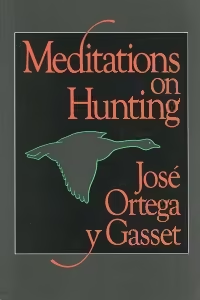
Meditations on Hunting: Ortega y Gasset, José: Free Download and Borrow: Internet Archive.
Hunting and Human Nature
Return to Nature: Hunting is seen as a way for modern humans to temporarily escape civilization and return to a more primal state.
Vocational Occupation: The author views hunting as a vocational activity that can provide a sense of fulfillment and happiness when pursued with passion.
Controversial Aspects
Sport vs. Utilitarian Hunting: Ortega y Gasset controversially favors sport hunting over utilitarian hunting, viewing the former as morally superior. This stance has been criticized for its cultural arrogance and misunderstanding of subsistence hunting.
Elitist Perspective: Some critics argue that Ortega y Gasset’s views reflect an elitist worldview, disconnected from the realities of those who hunt for survival.



